Probation Violation Bonds: Can You Get One and How?
Can you get a bond for a probation violation? The answer depends on several factors, but here’s a quick look:
- Nature of Violation: Minor offenses increase your chances.
- Type of Original Offense: Misdemeanors often get more leniency compared to felonies.
- Judge’s Discretion: It’s up to the judge.
Violating probation can lead to serious consequences, including re-arrest and potential jail time. Probation is a legal agreement that allows you to serve your sentence outside jail under certain conditions. Violating these conditions can trigger legal actions, making it crucial to understand your options for posting bail.
When you violate probation, you can expect a judge to consider the severity of your original offense, the nature of the violation, and your overall behavior. Sometimes the judge will set bail, allowing you to continue your daily life while awaiting your court hearing. However, the process can be complex and varies widely depending on individual circumstances.
I’m Luke Ireland, a former law enforcement officer with over 22 years of experience working with various legal agencies. I have extensive knowledge of the court system and probation violations. Let’s dive deeper into how you can steer this challenging situation.
Understanding Probation Violations
Common Ways to Violate Probation
Violating probation can happen in several ways, often categorized as either technical violations or substantive violations.
Technical Violations: These are administrative failures, like missing meetings with your probation officer, failing to pay court fees, or not completing community service hours. For instance, failing a drug test is a common technical violation. Many individuals struggle with addiction and relapse, making it challenging to stay clean without proper support.
Substantive Violations: These are more serious and involve committing new crimes while on probation. For example, getting arrested for theft or drug possession while on probation constitutes a substantive violation.
Here are some common ways people violate probation:
- Failed Drug Tests: Drug tests are standard for many on probation. Relapsing or using drugs can lead to a failed test, which is a frequent violation.
- Failure to Pay Court Fees: Not paying fines or court-appointed attorney fees on time can also lead to a violation.
- Absconding: Failing to report to your probation officer or leaving the jurisdiction without permission is considered absconding and is a serious violation.
Consequences of Violating Probation
Violating probation triggers a series of legal actions that can have severe consequences.
Arrest: Depending on the terms of your probation, you might be arrested immediately upon a violation. If your probation order states “Arrest If Violated,” you will be rearrested, booked in jail, and given a court date.
Court Hearing: After your arrest, you will appear before a judge. The judge will ask if you need a court-appointed attorney. Then, a hearing date will be scheduled. If you do not get or cannot pay for a bond, you will remain in jail until the hearing.
Potential Penalties: The penalties for violating probation can vary. They may include:
- Quick Dip: Short-term jail confinement to re-emphasize the seriousness of the probation terms.
- Fines: Additional fines may be imposed as a penalty.
- Confinement Programs: You might be ordered to participate in specific programs designed to address the violation.
- Revocation: The most severe consequence is the revocation of probation, leading to serving the original prison sentence.
Understanding the types of violations and their consequences can help you steer the probation process more carefully and avoid potential pitfalls.

Next, let’s explore whether can you get a bond for a probation violation and what factors influence such decisions.
Can You Get a Bond for a Probation Violation?
Factors Influencing Bond Eligibility
Whether you can get a bond for a probation violation depends on several key factors:
Nature of the Violation: Violations can be technical (like missing a meeting) or substantive (like committing a new crime). Technical violations are generally seen as less severe, making you more likely to get a bond.
Misdemeanor vs. Felony: If your violation involves a misdemeanor, you have a better chance of being granted bail. For example, missing a probation meeting is less severe compared to committing a new felony offense.
Criminal History: Judges will look at your past. If this is your first violation, you might be viewed more favorably. Repeat offenders might find it harder to get a bond.
Risk Assessment: Courts consider whether you pose a flight risk or a danger to the community. Strong family and community ties can improve your chances of getting a bond.
Bond Process for Probation Violations
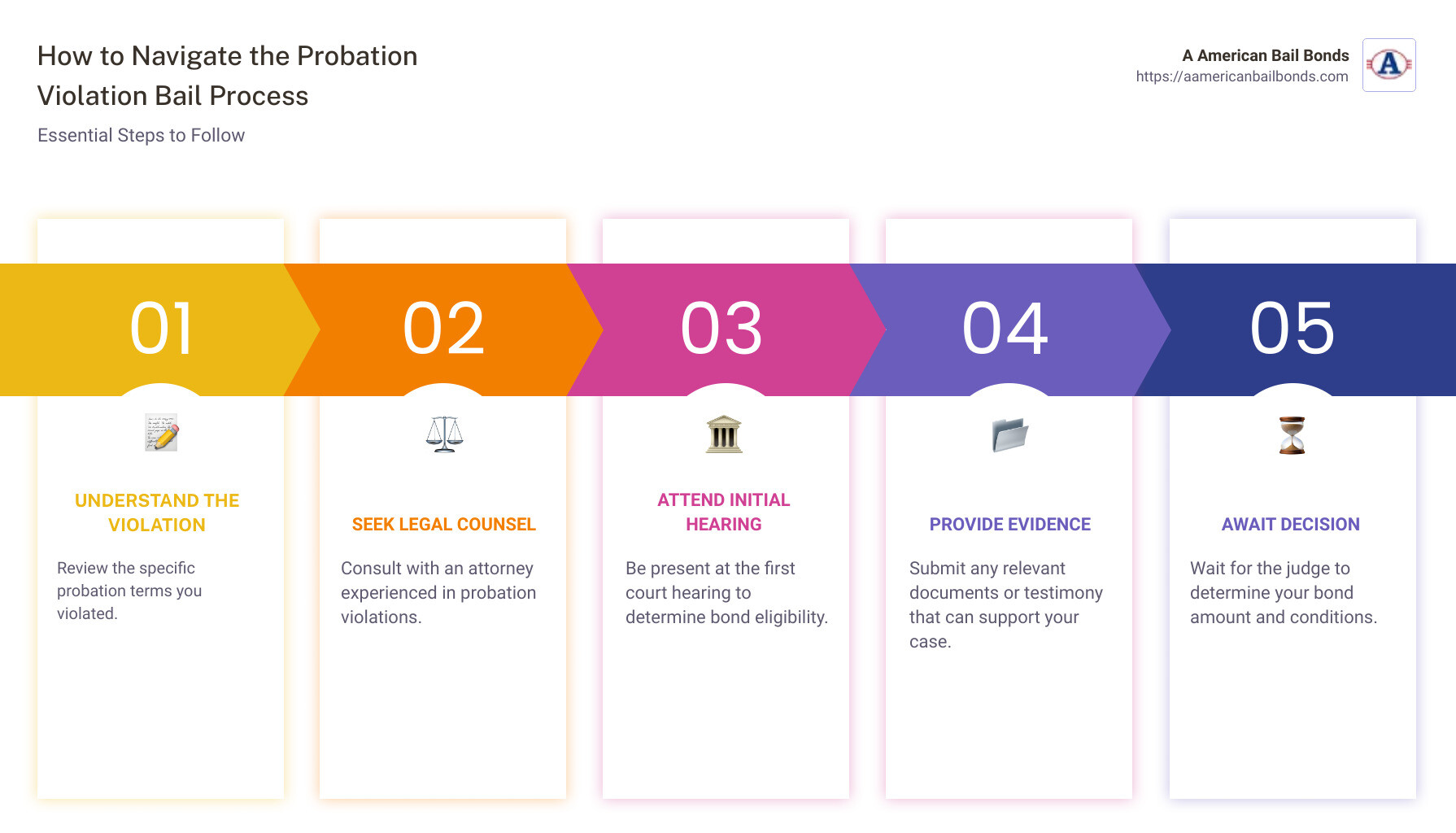
The process of getting a bond for a probation violation involves several steps:
Initial Hearing: After being arrested for a probation violation, you will have an initial hearing. This is where the decision to grant a bond is first considered.
Magistrate vs. Judge: Initially, a magistrate might handle your case. If the violation is severe, a district or superior court judge will review it. For example, in North Carolina, the first court date is usually within 30 days of being served.
Bond Amount Determination: The bond amount isn’t arbitrary. It depends on several factors, including the severity of the original offense and the nature of the violation. In some cases, a bond motion will be filed by your attorney to request bail.
Judicial Discretion: The judge has the final say. They will consider your criminal history, the nature of your probation violation, and any recommendations from your probation officer.
For instance, in Florida, the court can issue a bond for a pending probation violation according to Fla. Stat. § 948.06(4). This statute allows the judge to decide whether to grant a bond, considering whether you pose a risk to the community.
Understanding these factors can help you and your attorney build a strong case for getting a bond.
Next, let’s discuss what happens after a probation violation arrest, including the arrest procedures and scheduling of court dates.
What Happens After a Probation Violation Arrest?
Probation Violation Hearing
Once arrested for a probation violation, the first step is a probation violation hearing. This hearing is crucial as it determines whether you violated the terms of your probation and what the consequences will be.
Arrest Procedures
Upon arrest, you’ll be taken to jail. You may be held without bond until your hearing, especially if the violation is severe. In some cases, a judge might allow you to post a bond, but this depends on various factors like the nature of your violation and your criminal history.
Court Date Scheduling
After your arrest, the court will schedule a hearing. The timing can vary, but it’s usually within a few days to a couple of weeks. This hearing is your opportunity to present your case and contest the allegations against you.
You have the right to an attorney at your probation violation hearing. Given the complexities involved, having legal representation can significantly impact the outcome. An attorney can help you steer the legal process, present evidence, and negotiate with the prosecution.
Hearing Process
During the hearing, the judge will ask if you admit to the violation or if you want a trial. If you choose a trial, it will resemble a regular court trial, complete with witness testimonies and evidence presentation.
Evidence Presentation
Both sides will present their evidence. The prosecution, often represented by the district attorney, will present evidence of your violation. This can include testimonies from your probation officer and other witnesses. You can also present evidence to refute the claims, such as proof of compliance with probation terms.
Sentencing Options
If the judge finds that you violated your probation, several outcomes are possible:
- Quick Dip: Short jail time, usually a few days.
- Fines: Monetary penalties.
- Programs: Enrollment in specific programs like drug or alcohol treatment.
- Confinement Programs: Longer jail terms, such as 30, 60, or 90 days.
- Revocation: Complete revocation of probation, leading to imprisonment.
Role of the Probation Officer and District Attorney
Probation Officer’s Influence
Your probation officer plays a significant role in the hearing. They will usually be the main witness for the state, providing detailed accounts of your alleged violations. The judge often gives considerable weight to their testimony.
DA’s Involvement
The district attorney (DA) also has a crucial role. They can argue for harsher penalties or negotiate with your attorney for a more lenient outcome. The DA’s recommendations can influence the judge’s decision.
Judge’s Decision
Finally, the judge will make the ultimate decision. They will consider the evidence, the recommendations from the probation officer and DA, and any arguments your attorney presents. The judge’s ruling will determine whether your probation continues, is modified, or is revoked altogether.
Understanding these steps can help you prepare for what lies ahead. Next, we’ll explore the potential penalties for probation violations and alternatives to revocation.
Potential Penalties for Probation Violations
When you violate probation, the consequences can be severe. Let’s break down the potential penalties and some alternatives to revocation.
Quick Dip
A “quick dip” is a short stint in jail, typically lasting a few days. It’s designed to be a wake-up call, giving you a taste of what could happen if violations continue.
Fines
Sometimes, the judge may impose a fine. This is usually in addition to other penalties and serves as a financial deterrent against future violations.
Confinement Programs
There are specific programs aimed at rehabilitation that involve confinement. These programs can last 30, 60, or even 90 days. For instance, if you’ve been arrested for a drug offense, you might go through a confinement drug program rather than having your probation revoked.
Revocation Consequences
If your probation is revoked, you will have to serve the remaining time of your original sentence in confinement. This often means going back to prison to serve out the rest of your term.
Alternatives to Revocation
In some cases, the judge may choose alternatives to revocation. These options aim to correct your behavior without sending you back to prison.
Continuation of Probation
The judge may allow you to continue your probation without any additional penalties, especially if the violation is minor.
Specific Programs
Judges can impose specific programs as part of your probation terms. For example, you might be required to complete a Drug Alcohol Recovery Treatment (DART) program.
Diversion Programs
If you’re in a diversion program, violating probation can lead to different outcomes. The judge might revoke the program and sentence you for the original crime, or they may allow you to continue with a warning.
Understanding these potential penalties and alternatives can help you steer the probation violation process. Next, let’s dive into frequently asked questions about probation violation bonds.
Frequently Asked Questions about Probation Violation Bonds
What happens if you violate probation in North Carolina?
Violating probation in North Carolina can lead to serious consequences. The first thing that might happen is revocation of your probation. This means you could be sent back to jail to serve the rest of your original sentence.
Jail time is a common penalty for probation violations. Depending on the severity of the violation, you might spend a few days or even several months in jail.
In addition to jail time, the court can impose additional conditions on your probation. These might include more frequent check-ins with your probation officer, mandatory counseling, or increased community service hours.
Can you bail out of jail on a probation violation in Texas?
In Texas, the rules for bailing out on a probation violation depend on the type of probation you were on. For regular probation, there is generally no bond allowed. This means you will likely remain in jail until your hearing.
However, if you were on deferred adjudication probation, you might be eligible for a bond. This allows you to be released from jail while you await your court hearing. That the bond amount can be quite high, and it is ultimately up to the judge’s discretion.
What is the new bond law in NC?
North Carolina has updated its bond laws to give judges more control over bond decisions. Under the new law, the judge’s attention is required for setting bond amounts, especially in serious cases. This means that magistrates, who often set initial bond amounts, now play a smaller role in these decisions.
The effective date for the new bond law varies by jurisdiction, but it generally aims to ensure that bond decisions are fair and consider the individual circumstances of each case.
Understanding these frequently asked questions can help you steer the complexities of probation violation bonds. For more detailed guidance, always consult with a knowledgeable attorney.
Securing Probation Violation Bail Bonds
Navigating the complexities of probation violations can be overwhelming. The consequences are severe, and understanding whether you can get a bond for a probation violation is crucial.
A American Bail Bonds is here to help. With our expertise, we provide the support you need to secure your release. Our team understands the intricacies of the legal system and will guide you through every step.
Legal Assistance: When facing a probation violation, having the right legal assistance is essential. Our experienced bail bondsmen work closely with attorneys to ensure that your rights are upheld and that you understand the process.
Securing Release: Getting out of jail quickly is a priority. We specialize in providing fast and efficient bail bond services, ensuring that all conditions are met to minimize the risk of re-arrest. Our goal is to help you get back to your life while you await your court date.
For more information on how we can assist you with probation violation bonds, visit our Probation Violations Bail Bond Services page. We’re here to provide the support and guidance you need during this challenging time.